For about two minutes, I wanted to close my entire shop.
Not rebrand. Not pivot. Close. Deactivate everything, pack up the heat press, and pretend Neurospice Design Shop never existed. Because someone left a 2-star review on my Oracle of the Moonlit Dumpster deck, and they said the art “very much seems AI-generated.”
They weren’t wrong. Not entirely.
But they weren’t right, either.
What the Review Said
The reviewer liked the physical quality of the cards. Said they felt nice in the hand. But they couldn’t find anything on my listing, my store, my website, or my Facebook page confirming or denying that the art was AI-assisted.
Then they listed specific problems. The Hanged One has three legs. The Moon card’s reflection is missing. The Fool’s rollerskates have the wrong wheels. The borders are inconsistent. Two stars.
I read it and my stomach dropped.
What They Missed
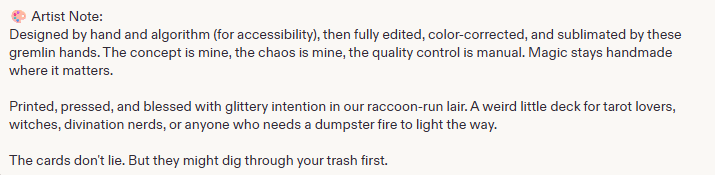
Here’s the thing. My listing has an Artist Note that says, word for word: “Designed by hand and algorithm (for accessibility), then fully edited, color-corrected, and sublimated by these gremlin hands. The concept is mine, the chaos is mine, the quality control is manual.”
My shop’s About page says the same thing in different words. The designs start digital, get refined with AI assistance (for accessibility, carpal tunnel is real), and pass through real hands before they reach yours.
I disclosed. In my own voice, in multiple places. They looked and didn’t read it, or read it and didn’t register it. I can’t control that. But it stung to be accused of hiding something I’d put in plain sight.
What They Got Right (and Wrong)
Let’s go through their specific complaints, because I think this matters.
The Hanged One’s “three legs.” That’s a tail. It’s a raccoon. Raccoons have tails. At mini card size, I can see how someone might count it as a third leg, and that’s a fair legibility note. But it’s not an anatomy error.
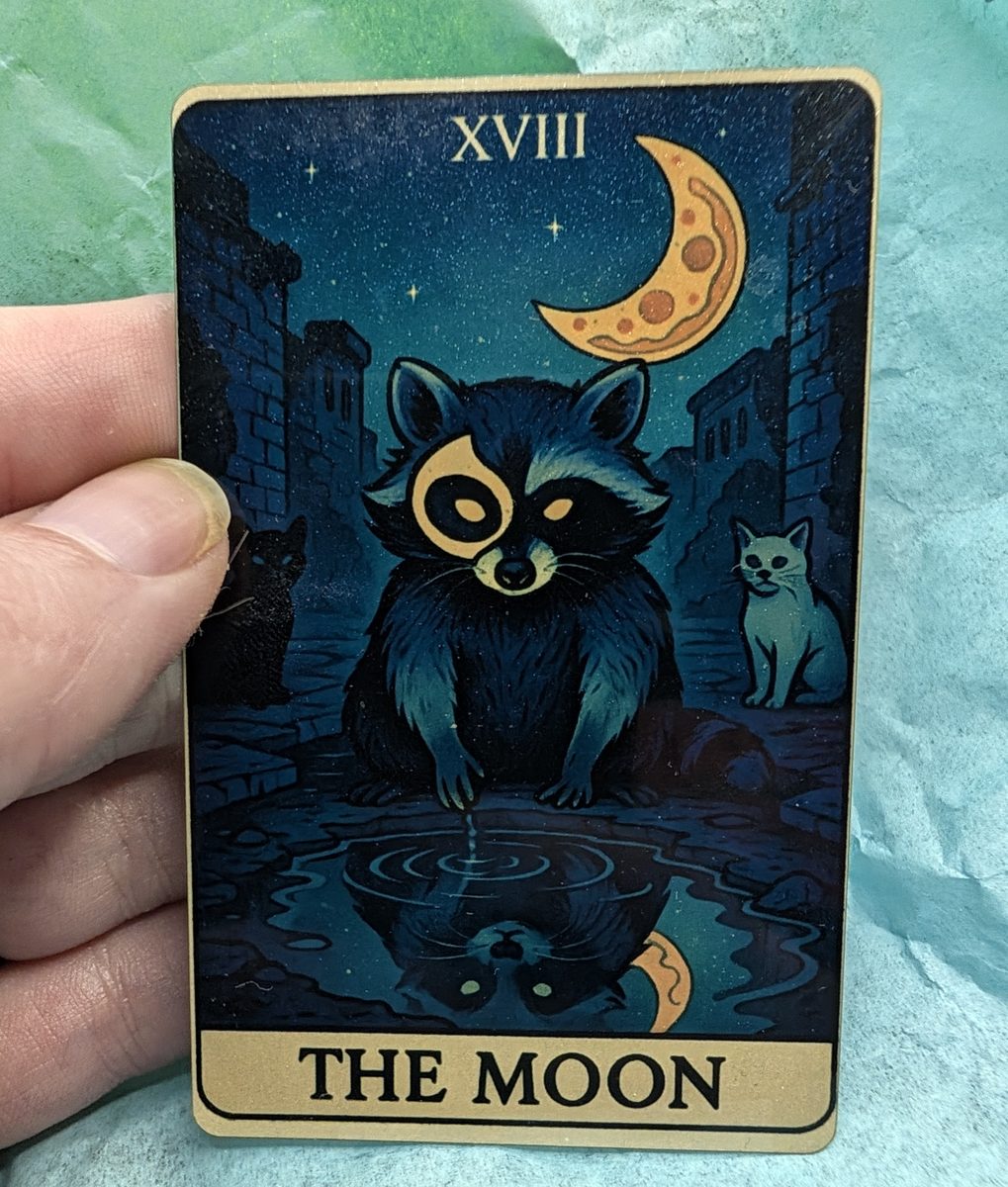
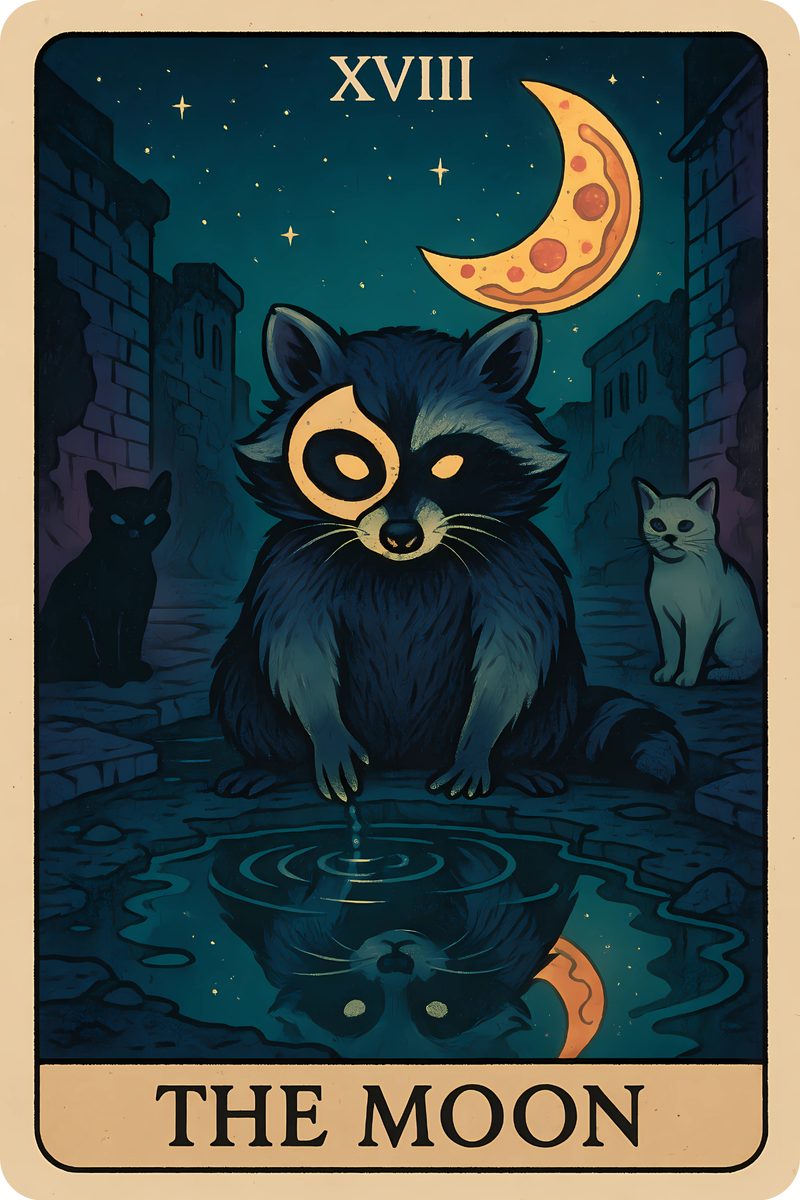
The Moon’s “missing reflection.” The reflection is there. The raccoon’s face is reflected in the puddle. The pizza moon is reflected as a crescent in the water. It’s literally right there on the card. This one hurt the most because The Moon is my favorite card in the deck.
The Fool’s rollerskates. Yeah. Those wheels are wrong. One foot has a wheel situation happening and the other is just vibes. That’s on me. I should have caught it. I didn’t.
The inconsistent borders. Those were intentional. I was carrying the look over from Tarot of the Tacky, my own deck, which has done incredibly well with exactly that aesthetic. I was building on what already worked. The inconsistency was a design choice, not a defect. But without that context, I understand why it looked like a mistake.
So out of five specific complaints: two were wrong, one was intentional, and one was a fair catch. The Fool’s rollerskates are genuinely fucked. I own that.
Why I Use AI in the First Place
Here’s the part that made me want to close the shop.
I didn’t start using AI because I stopped wanting to make my own art. I started using it because my wrist stopped letting me.
Carpal tunnel. The kind that builds up over years of drawing, designing, typing, clicking, crafting. The kind that doesn’t go away just because you have ideas burning a hole in your brain at 2 AM. My hands don’t do what they used to do, and that already makes me feel like less sometimes. Like I’m cheating at my own craft.
So when someone looks at the work I’ve poured days into refining, editing, color-correcting, printing, pressing, and cutting, and reduces it to “this is AI-generated” like I just typed a prompt and hit print… that knife doesn’t just land. It twists. Because it finds a wound that was already there.
What “Days of Refinement” Actually Looks Like
Each card in the Oracle of the Moonlit Dumpster took multiple rounds of generation and editing. I used ChatGPT’s image generation, not because it’s easy, but because the iteration process let me refine concepts without destroying my wrists.
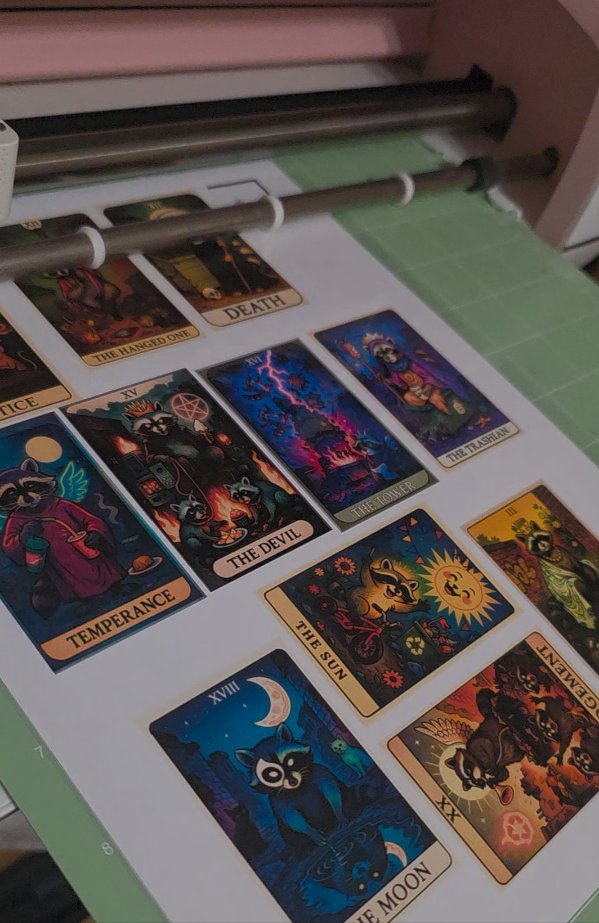
Then each card got color-corrected by hand. Edited. Reviewed. Formatted for print.
Then I spent two hours at the heat press, sublimating every single card. In a room that got hot enough to make me nauseous. Taking breaks to step away from the heat, then going back. Pressing, checking, pressing again.
That’s not “AI art.” That’s a hybrid process where AI handles the parts my body can’t do anymore, and my hands, my eyes, and my judgment handle everything else. The concept is mine. The curation is mine. The quality control is manual. The physical production is mine.
Did I miss the rollerskates? Yes. That’s a quality control failure and it’s mine to own. But a missed detail isn’t the same as a lack of care.
The Part That Almost Broke Me
The review didn’t just critique a product. It poked at the specific thing I already carry guilt about.
I used to draw. I used to design everything from scratch. Carpal tunnel took that from me, and I adapted. I found a way to keep making things, to keep running a shop that started as survival and turned into something real. But there’s a voice in the back of my head that already whispers “you’re not a real artist” on bad days.
That review was that voice, except out loud. Except public. Except attached to a star rating.
For about two minutes, I believed it.
Then I looked at my listing. I looked at my About page. I looked at The Moon card and saw the reflection that is very clearly there. And I remembered that I built this shop from a loud brain and a louder job and a need to put feelings somewhere that wasn’t a pillow I was screaming into.
What Happens Next
I’m going back through every card in the deck with fresh eyes. If there are other details I missed, I’ll find them. The Fool’s getting new skates. The next version of this deck will be better because someone cared enough to be specific in their critique, even if some of those specifics were wrong.
I’m also leaving my disclosure exactly where it is. In my listing. In my About page. In this blog post. If someone doesn’t read it, that’s not something I can fix. But no one gets to say I wasn’t transparent.
This shop is for the weird kids, the tired adults, and anyone who’s ever used dark humor as load-bearing architecture. I make things with whatever tools my body will let me use, and I make them with intention. Every single one.
The cards don’t lie. But they might dig through your trash first.
Laura runs Neurospice Design Shop from North Carolina with the help of one raccoon, one judgmental cat, one very patient partner, and a brain that won’t shut up. Browse the shop on Etsy or poke around the Bestiary Oracle right here on the site.